Sailbotix launched solar-powered USV
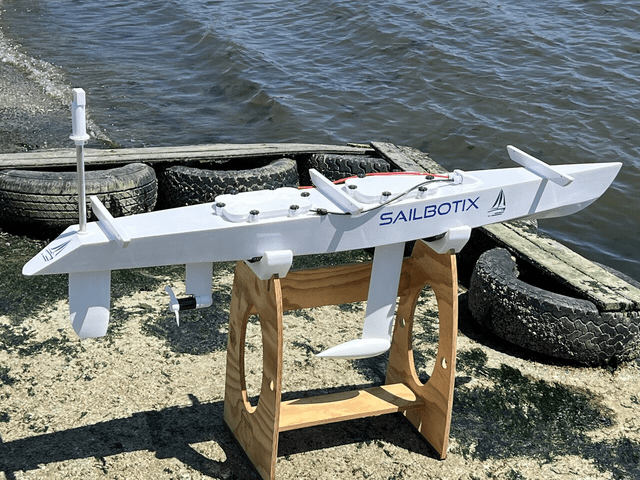
Sailbotix, Canada-based USV developer, conducted the maiden launch of our new solar-powered uncrewed surface vehicle (USV) just off the coast of Victoria, British Columbia, Canada. As reported the test was successful, with all core systems performing exactly as designed, including propulsion, navigation, communications, and onboard computing.
This autonomous vessel was built from the ground up over a two-month development sprint. It measures just under 2 meters (199 cm) to comply with Transport Canada regulations for small uncrewed craft, and features a modular hull system that can be configured either as a trimaran (supporting a 200-watt solar array) or a monohull (100-watt array), depending on mission requirements.
At sea, the USV demonstrated exceptional efficiency. It cruised steadily at 2 knots (≈4 km/h) using less than 5 watts, and reached 4 knots at just 120 watts. The propulsion system is built around a custom immersible motor with ultra-low KV for direct-drive efficiency, ceramic saltwater-resistant bearings, and a fully epoxy-potted stator and rotor to handle harsh marine conditions. During the maiden voyage, the vessel successfully established connections via LTE and Iridium Short Burst Data (SBD). It’s also designed to support SpaceX Starlink, and future upgrades will enable direct-to-cell Starlink integration—allowing seamless communication both nearshore and offshore through a single modem.
This solar USV is built on an open-source architecture, combining ArduPilot—the same system used in many military and research applications—with a Raspberry Pi Compute Module 4 (CM4) for onboard computing. Our software is fully open source, enabling users to integrate their own sensors, control logic, and payloads with ease.
?? Source: Sailbotix
See also related
Companies